
Scintillation spectrometry
Radioactivity analysis explained
A scintillation spectrometer is an instrument designed to detect, measure, and analyze ionizing radiation by converting radiation energy into measurable electrical signals. It is widely used in physics, nuclear science, medicine, environmental monitoring, and industry to identify radioactive materials and to determine the energy distribution of radiation. At its core, the scintillation spectrometer combines the physical phenomenon of scintillation with electronic signal processing to perform radiation spectroscopy, allowing scientists and technicians not only to detect radiation but also to understand its nature and origin.
Why a scintillation spectrometer is used for radioactivity analysis
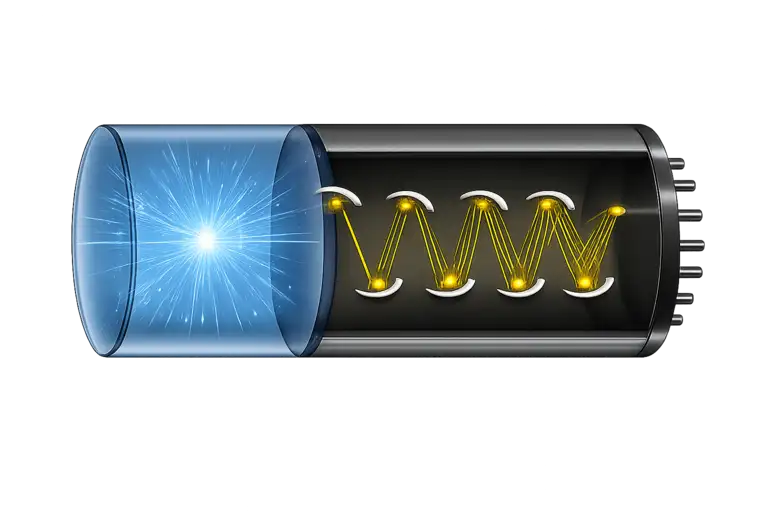
A scintillation spectrometer is a type of radiation detector that measures the energy of incoming radiation such as gamma rays, X-rays, or charged particles-by using a scintillating material. A scintillator is a substance that emits tiny flashes of visible or ultraviolet light (called scintillations) when it absorbs energy from ionizing radiation. These light flashes are then converted into electrical signals, amplified, and analyzed to produce an energy spectrum.
Unlike simple radiation counters that only register the presence of radiation, a scintillation spectrometer provides spectroscopic information, radioactivity analysis, meaning it can distinguish radiation of different energies. This capability is essential for identifying radioactive isotopes and quantifying radiation sources. Simply explained, scintillator can detect or identify radiological threats and can be built-in EXPLONIX analyzer.
How a Scintillation Spectrometer Works
Scintillation Detector (Scintillator Crystal)
The process begins when ionizing radiation enters the scintillator material, which is commonly made of substances such as sodium iodide doped with thallium (NaI(T1)), cesium iodide, or organic plastics. When radiation interacts with the atoms in the scintillator, it deposits energy, exciting the atoms and causing them to emit light as they return to their ground state. The amount of light produced is approximately proportional to the energy of the incoming radiation.
Light Collection and Photodetector
Signal Processing Electronics
The electrical pulses are amplified and shaped by electronic circuits. The pulse height (or amplitude) corresponds to the energy deposited in the scintillator. These pulses are then sorted and recorded by a multichannel analyzer, which groups them according to their amplitudes.
Energy Spectrum Formation
The final output is an energy spectrum-a graph showing the number of detected events as a function of energy. Peaks in the spectrum correspond to specific radiation energies, allowing identification of radioactive isotopes and quantitative radioactivity analysis.
Who Can Use a Scintillation Spectrometer
Scintillation spectrometers are used for radioactivity analysis by a wide range of professionals and institutions, including:
- Security and regulatory authorities, responsible for radiation safety, border control, and nuclear safeguards.
- Physicists and nuclear scientists, who study atomic nuclei, particle interactions, and radiation processes.
- Medical professionals and medical physicists, particularly in nuclear medicine and radiation therapy.
- Environmental scientists, who monitor radioactive contamination in air, water, soil, and food.
- Engineers and technicians, working in nuclear power plants, industrial inspection, and quality control.
- Researchers and educators, using spectrometers for laboratory experiments and teaching purposes.

Where Radioactivity Analysis Can Be Used
Border Crossings & Ports
Portable scintillation spectrometers are used at borders and ports to detect and prevent the movement of illegal radioactive materials, ensuring public safety and national security.
Research Laboratories
Scintillation spectrometers support nuclear and particle physics research by accurately measuring radiation energy and intensity.
Hospitals & Medical Imaging
Used in gamma cameras, PET scanners, and diagnostic laboratories to provide precise medical imaging and diagnostic results.
Nuclear Power Plants
Scintillation spectrometers are essential for radiation monitoring, fuel analysis, and maintaining safe reactor operations.
Environmental Monitoring
These instruments help detect and track radioactive pollution in air, water, and soil to protect the environment.
Industrial Applications
Used in non-destructive testing, quality control, and material analysis across various industrial sectors.
Fieldwork & Emergency Response
Portable and rugged scintillation spectrometers are ideal for geological surveys and emergency radiation assessment.
Why the Scintillation Spectrometer Was Invented
The invention of the scintillation spectrometer was driven by the need for more sensitive, faster, and more informative radiation detection methods. Early radiation detectors, such as photographic plates and Geiger-Miller counters, could detect radiation but provided limited or no information about its energy. As nuclear physics developed in the early 20th century, scientists required instruments capable of accurately measuring radiation energies to understand nuclear structure and radioactive decay.
Who Can Use a Scintillation Spectrometer
Nuclear & Particle Physics
Used to study radioactive decay, nuclear reactions, and particle interactions, contributing to fundamental scientific research.
Medical Imaging & Diagnostics
Forms the basis of gamma cameras and PET scanners, enabling doctors to visualize physiological processes inside the human body.
Radiation Protection & Safety
Monitors radiation exposure in workplaces and the environment, helping ensure compliance with safety regulations.
Environmental Monitoring
Detects and quantifies radioactive contamination during routine surveillance, after nuclear accidents, and in long-term studies.
Environmental Monitoring
Detects and quantifies radioactive contamination during routine surveillance, after nuclear accidents, and in long-term studies.
Industrial Applications
Used in non-destructive testing, thickness measurement, density analysis, and detection of internal material defects.
Security & Nonproliferation
Essential for detecting and identifying radioactive materials in security screening and anti-smuggling operations.